

Porto unfolds slowly. Skipping Port wine isn't an option. But dedicating 48 hours to it is a waste. This guide spreads the time better: local food, a Douro walk, natural wine in Foz, a francesinha in a tavern tourists ignore. No checklist. Just method.
10 min read
You can spend 48 hours in Porto doing what every tourist does: photo on the Ribeira, Port wine tasting, dinner with fado, photo of the D. Luís Bridge. You leave with the city on your Instagram. You don't leave with the city on your skin.
This guide spreads the time better.
Day 1 morning — Bolhão, Aliados, Sé
TL;DRStart at the Mercado do Bolhão (Rua Formosa, 8am-6pm). It reopened in 2022 after 4 years of works. It's no longer the chaotic market it was 30 years ago, but it's still Porto's real market. Buy a tremoço (lupin bean), try Serra cheese straight from the vendor, drink a galão (hot milky coffee) at the counter.
Start at the Mercado do Bolhão (Rua Formosa, 8am-6pm). It reopened in 2022 after 4 years of works. It's no longer the chaotic market it was 30 years ago, but it's still Porto's real market. Buy a tremoço (lupin bean), try Serra cheese straight from the vendor, drink a galão (hot milky coffee) at the counter.
Walk down Avenida dos Aliados, the city's civic centre. São Bento railway station has the best tile work in Portugal — 20,000 blue azulejos hand-painted in 1910 telling the country's history. Free to enter. It's not a visit — you walk through to catch the train.
Climb up to the Sé do Porto (Cathedral, 9am-12:30pm). Impressive view. £2.50 / €3 to enter the cloister.
Lunch: head to Cantinho do Avillez (Rua da Mouzinho da Silveira, 166). It belongs to José Avillez (Michelin-starred in Lisbon), but the Porto outpost is more relaxed. Octopus lagareiro-style €22, duck rice €18. Not a tavern, but a serious lunch.
Day 1 afternoon — Ribeira, Douro, Vila Nova de Gaia
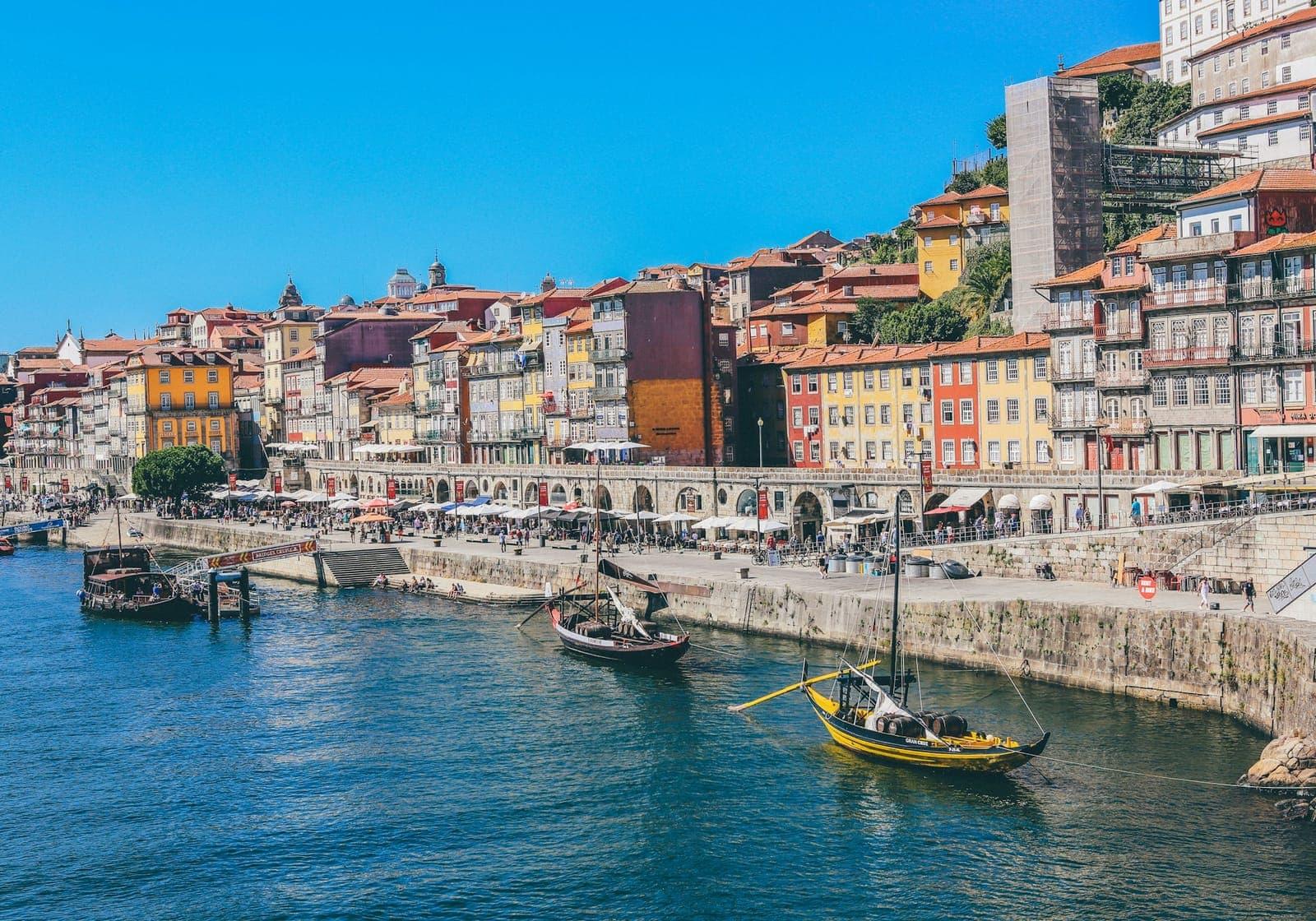
TL;DRThe Ribeira is a compulsory cliché. Do it in 1 hour: walk along the Douro from Praça da Ribeira to the Dom Luís I Bridge, cross it on the upper deck (pedestrians and metro only), take your photos. The other side is Vila Nova de Gaia — technically another city, but home to all the Port wine cellars.
The Ribeira is a compulsory cliché. Do it in 1 hour: walk along the Douro from Praça da Ribeira to the Dom Luís I Bridge, cross it on the upper deck (pedestrians and metro only), take your photos.
The other side is Vila Nova de Gaia — technically another city, but home to all the Port wine cellars. Nearly 30 of them open to visitors.
The rule: visit just one. Each tour takes 90 minutes. Any more and the information blurs.
I recommend Graham's (Rua Rei Ramiro, 514). 200 years of history, guided tour €18, tasting of 3 wines included. You leave with a real grasp of what Tawny, LBV, and Vintage actually mean — beyond the sugar.
Avoid: Sandeman (mass tourism), Calém (dull).
Dinner: cross back from Gaia on a barco rabelo (€3, 5 min, every 15) and eat at Cervejaria Brasão Aliados (Rua de Ramalho Ortigão, 28). Classic francesinha, thin chips, a cold imperial lager. €15 a head. Old-school, no reservations, 20-min wait.
Day 2 morning — Foz, natural wine, bookshop
TL;DRTake tram 1 from the Ribeira to Foz do Douro. 25 min, €5. The tram is genuinely vintage — 1872 — and runs along the riverside. Foz is Porto's "bourgeois" zone. 1920s mansions, a seaside promenade, third-wave cafés. It's not historic Porto, but it's contemporary Porto, where new money lives.
Take tram 1 from the Ribeira to Foz do Douro. 25 min, €5. The tram is genuinely vintage — 1872 — and runs along the riverside.
Foz is Porto's "bourgeois" zone. 1920s mansions, a seaside promenade, third-wave cafés. It's not historic Porto, but it's contemporary Porto, where new money lives.
Breakfast: Combi Coffee Roasters (Av. de Brasília, 130). Micro-roastery coffee, butter croissant, Atlantic view. €8.
Walk along the seafront to the Pérgola da Foz (1930s stone structure). A gentle 40-min stroll.
Take an Uber to Cedofeita (€7, 12 min). Porto's hipster neighbourhood. Galleries, vinyl shops, vintage stores, architects' cafés.
A Pérola do Bolhão (Rua Sá da Bandeira, 145) — not in Cedofeita, just 5 min away — has one of Portugal's finest Art Nouveau façades (1917). Today it's a gourmet grocer. Pause for the façade, buy tins of sardines to take home.
Lunch: Tapabento Bolhão (Rua de Sá da Bandeira, 73). Portuguese small plates + natural wines. 30-reference list. Cured octopus with sweet potato €14, courgette fritters with prawns €12. A good €30 a head.
Day 2 afternoon — Lello bookshop + Clérigos + dinner
TL;DRLivraria Lello (Rua das Carmelitas, 144). Allegedly the "most beautiful in the world". €8 entry, refunded if you buy a book over €15. Go at 2:30pm (between tour-group shifts). 30 min is enough. 5 min away: Torre dos Clérigos (Rua de São Filipe Nery).
Livraria Lello (Rua das Carmelitas, 144). Allegedly the "most beautiful in the world". €8 entry, refunded if you buy a book over €15. Go at 2:30pm (between tour-group shifts). 30 min is enough.
5 min away: Torre dos Clérigos (Rua de São Filipe Nery). €5 to climb 240 steps. Best view in Porto.
From the top of Clérigos you see the whole city. Take the photos, come down, head to Carmo.
Igreja do Carmo (Rua do Carmo) — blue tiles covering its entire side wall, 1912. Quick photo.
Coffee and pause: Majestic Café (Rua Santa Catarina, 112). Belle Époque café from 1921, now too pricey to be a regular (galão €5), but worth one visit. Stay 30 min.
Farewell dinner: Cantina 32 (Rua das Flores, 32). Contemporary, relaxed, Portuguese food with modern technique. Caramelised cod, Iberian pork, mountain cheeses. €40 a head with wine. Book a week ahead.
What NOT to do in Porto
TL;DRDon't eat lunch on the Ribeira. Every restaurant there is pure tourism. High prices, mediocre food. Even the ones that look local. Don't visit more than one Port wine cellar. Information overload. You won't remember the difference later. Don't lunch at Brasão Coliseu when you can go to Brasão Aliados.
- Don't eat lunch on the Ribeira. Every restaurant there is pure tourism. High prices, mediocre food. Even the ones that look local.
- Don't visit more than one Port wine cellar. Information overload. You won't remember the difference later.
- Don't lunch at Brasão Coliseu when you can go to Brasão Aliados. Coliseu is the tourist version.
- Don't buy a metro pass. Porto is small. Walking + occasional Uber is enough.
- Don't try the Douro as a day-trip. It's 1h30 each way by car. To Pinhão (heart of the Douro), 2h. A day-trip is a sprint. Save it for another trip.
Get one journey a week.
Voyspark editorial newsletter — long-forms, tips and discoveries that don’t fit on Instagram. Weekly, no ads.
No spam. Unsubscribe in 1 click.
Where to stay
TL;DRTorel 1884 (Rua de Cândido dos Reis, 184) — boutique 5-star in the centre. €280-450 a night. Bar with Douro view. Pestana Vintage Porto (Praça da Ribeira) — 17th-century palace on the riverside. €220-380. The Editory House Ribeira (Rua do Infante D.
- Torel 1884 (Rua de Cândido dos Reis, 184) — boutique 5-star in the centre. €280-450 a night. Bar with Douro view.
- Pestana Vintage Porto (Praça da Ribeira) — 17th-century palace on the riverside. €220-380.
- The Editory House Ribeira (Rua do Infante D. Henrique) — modern design, mid-size. €180-260.
Avoid Airbnb on the Ribeira (expensive and noisy).
Practical notes
TL;DRFlights: London → Porto direct, 2h30, £60-180 return (TAP, Ryanair, easyJet). New York → Porto via Lisbon (TAP), ~9h, $700-1,100 round trip. Language: European Portuguese. English is widely spoken in restaurants and hotels in the centre. The Portuense are more reserved than Lisboetas but warm once you talk.
Flights: London → Porto direct, 2h30, £60-180 return (TAP, Ryanair, easyJet). New York → Porto via Lisbon (TAP), ~9h, $700-1,100 round trip.
Language: European Portuguese. English is widely spoken in restaurants and hotels in the centre. The Portuense are more reserved than Lisboetas but warm once you talk.
Payment: Cards everywhere. Visa/Mastercard accepted. Some cash useful for the markets.
Weather:
- Summer (Jun-Sep): 22-28°C, dry, long days. Ideal but pricier.
- Autumn (Oct-Nov): 16-20°C, occasional rain. Harvest season — perfect for the Douro.
- Winter (Dec-Feb): 8-14°C, wet. Cheaper, fewer tourists, better for introspection.
Don't forget:
- Comfortable shoes. Porto is all hills and cobblestones.
- A light jacket year-round — Atlantic breeze every evening.
- Offline translator: European Portuguese menus can baffle even Spanish speakers.
Porto rewards the slow walker. Walk that way.
Porto compared to other European city breaks
TL;DRIf you've done Lisbon, Porto feels like its quieter, granitic older brother — smaller scale, more vertical, and visibly poorer in a way that makes the dining bills feel surreal. If you've done Seville, Porto trades the heat and orange trees for cold Atlantic mist and azulejo walls.
If you've done Lisbon, Porto feels like its quieter, granitic older brother — smaller scale, more vertical, and visibly poorer in a way that makes the dining bills feel surreal. If you've done Seville, Porto trades the heat and orange trees for cold Atlantic mist and azulejo walls. If you've done Edinburgh, the comparison is sharper than you'd expect: hilly old town, river dividing two halves, a famous indie bookshop, and that same northern temperament of "warm once you talk".
For Americans and Britons used to Barcelona or Amsterdam, Porto will surprise you with how walkable everything is. The historic centre is roughly 2 km across. You can cross it in 25 minutes — but you won't, because every third corner has a bakery or a wine bar that interrupts you.
Five honest mistakes English-speakers make in Porto
TL;DR1. Trying to use Spanish. Portuguese sounds nothing like Spanish to a Portuguese ear, and locals can find it mildly insulting. Stick to English or attempt a few Portuguese words. 2. Ordering coffee without specifying. "Coffee" in Portugal defaults to espresso.
- Trying to use Spanish. Portuguese sounds nothing like Spanish to a Portuguese ear, and locals can find it mildly insulting. Stick to English or attempt a few Portuguese words.
- Ordering coffee without specifying. "Coffee" in Portugal defaults to espresso. Ask for galão (milky, in a glass) or meia de leite (milky, in a cup) if you want something Anglo-friendly.
- Showing up at restaurants at 7pm. Most kitchens don't get going until 8pm. Tourists eating at 7 sit in empty rooms wondering why everyone said it was a great restaurant.
- Tipping 20%. Service is not customary in Portugal. €1-2 per person at a sit-down meal is generous; rounding up at a café is enough.
- Booking only central hotels and ignoring Foz or Cedofeita. A neighbourhood stay (4 nights+) reads the city differently than a Ribeira base.
An alternative 48 hours: slower Porto (for returning visitors)
TL;DRIf you've already done the tourist circuit, here's a second-visit itinerary that drops Lello, the Cathedral, and the Port cellars in favour of what reveals itself when you slow down. Day 1 morning: long breakfast at Padaria Ribeiro (Praça Guilherme Gomes Fernandes) — a proper pastel de nata, bola de berlim with house cream, counter coffee among lawyers heading to.
If you've already done the tourist circuit, here's a second-visit itinerary that drops Lello, the Cathedral, and the Port cellars in favour of what reveals itself when you slow down.
Day 1 morning: long breakfast at Padaria Ribeiro (Praça Guilherme Gomes Fernandes) — a proper pastel de nata, bola de berlim with house cream, counter coffee among lawyers heading to the courts. Then walk to the Casa da Música (Av. da Boavista). Even without a concert, the guided tour (€10, 1h) is worth it — Rem Koolhaas reinvented what a concert hall can look like. 25 min on foot from the centre, or take the metro (blue line).
Day 1 afternoon: Serralves (Rua Dom João de Castro, 210). Contemporary art museum + Art Deco villa + 18-hectare park. €20 combo ticket. Allow 3 comfortable hours. The park alone is worth the trip — it's Porto's green lung, mostly missed by visitors. Uber back to Foz, late afternoon at Praia do Molhe — promenade, a glass of Vinho Verde at Praia da Luz, Atlantic sunset.
Day 2 morning: climb to the Miradouro da Vitória (Rua de São Bento da Vitória). A viewpoint few tourists know because it hides in the old Jewish quarter. Coffee at Mistu (Rua de Cedofeita, 256) — specialty roast, French patisserie, local crowd. Buy wine at Garrafeira do Carmo (Rua do Carmo, 17) — small-producer Douro wines that don't leave the country.
Day 2 afternoon: commuter train to Espinho (20 min, €1.90). Beach town to the south, with one of Portugal's best fish markets (Tue, Thu, Sat mornings) and long beaches. Lunch of grilled sardines at one of the carapauzeiros along the seafront. Back to Porto by 6pm, dinner at a petiscos house.
This version costs less, walks more, and gives you the Porto the Portuense keep to themselves.
Five useful Portuguese phrases
TL;DR"Faz favor, a conta" — "The bill, please." "Tem mesa para dois?" — "Do you have a table for two?" "Uma imperial, se faz favor" — "A draught beer, please." (Porto also accepts fino.) "Obrigado / obrigada" — "Thank you" — change ending based on speaker's gender, not listener's.
- "Faz favor, a conta" — "The bill, please."
- "Tem mesa para dois?" — "Do you have a table for two?"
- "Uma imperial, se faz favor" — "A draught beer, please." (Porto also accepts fino.)
- "Obrigado / obrigada" — "Thank you" — change ending based on speaker's gender, not listener's.
- "Bom proveito" — "Enjoy your meal" — a small gesture that earns smiles.
Key points
Frequently asked questions
No, not for just one day. Pinhão (heart of the Douro) is 2 hours from Porto by car, and the valley only makes sense with a local stay for sunset and dinner. Spend at least 2 nights in Pinhão or Régua. Or save it for another trip.
Conversation
…Log in to drop your insight
Serious conversation, no trolls. Moderated comments, linked to your Voyspark profile.
Sign in to commentLoading…

About the author
Curadoria Voyspark
2 years in the Voyspark editorial team
Time editorial da Voyspark — escritores, repórteres, fotógrafos e fixers em Lisboa, Tóquio, Nova York, Cidade do México e Marrakech. Coletivo. Sem voz corporativa. Cada peça com checagem cruzada por um editor regional e um chef ou curador local.
Expertise


